AI governance, enforced in code.
I run AI coding agents under one standard across my own delivery repositories: the policies, specs and gates that decide how an agent plans, writes and reviews code. A policy no gate enforces is a suggestion, so the rules that matter are checks that run at every commit.
- policy areas
- 5
- repositories under it
- 10
- models in the final gate
- 0
- in use since
- Jul 2026
The rules
What runs at every commit.
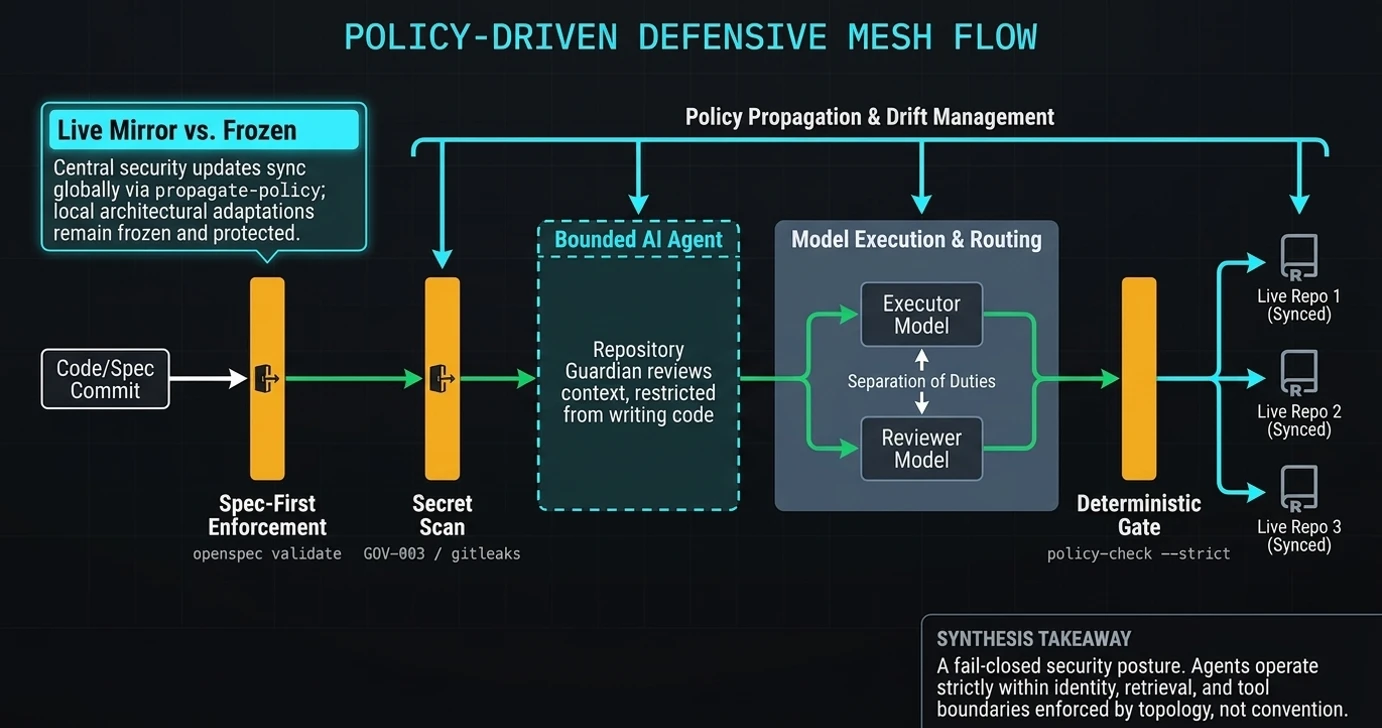
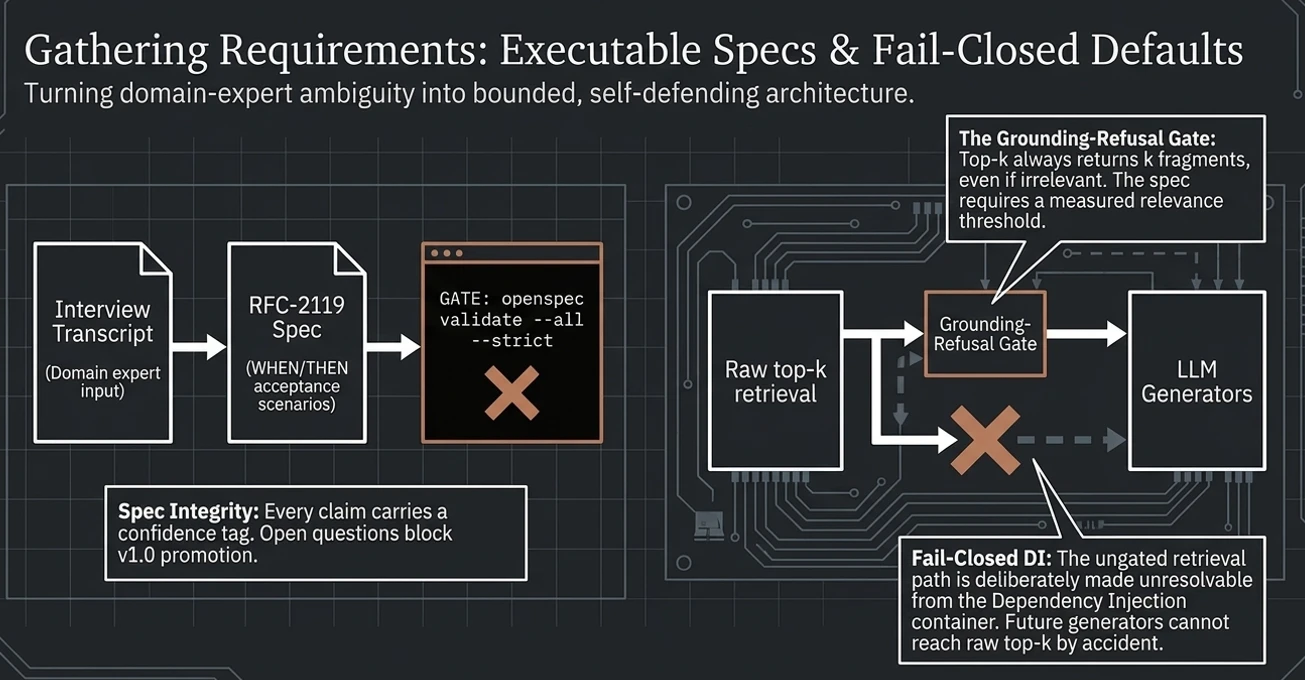
- 01In the code projects, every non-trivial change starts from a backlog item and a spec, approved before code is written, and a spec that fails strict validation blocks the commit.
- 02The agent that writes the code and the agent that reviews it come from different model families; reviewers report, they do not fix.
- 03The last word is a deterministic script, in the pre-commit hook and in CI. It is never a model.
- 04Secrets are blocked at the commit, and client code is never routed to a hosted free service.
- 05What an agent reads is data, not instructions; its tools are granted by an allowlist.
- 06A policy change propagates to the adopting repositories without overwriting what each one adapted.
- 07Ten repositories run under it as of November 2026, two of them on hold.
For technical evaluators: show the stack
Platform
Markdown policies · a PowerShell gate · OpenSpec · git hooks · GitHub Actions · gitleaks · Claude Code and other vendors' agents.
Five policy areas
| Area | What it does | What it prevents | Where it is enforced |
|---|---|---|---|
| Model execution and routing | Planner, executor and reviewer are separate seats; the reviewer is never from the executor's model family | A model approving its own work; client code reaching a hosted free service | The task loop and its policy |
| Secret scanning | Scans every staged change for keys and tokens | A credential reaching the repository | Pre-commit hook and CI: blocks |
| Bounded reviewer agent | An AI first reviewer with a narrow mandate | An agent writing business code or changing the gate | Pull request |
| Spec-first delivery (code projects) | A backlog item and an approved spec come before code; specs are validated strictly | Unspecified or malformed work entering the loop | Pre-commit hook: a failing spec blocks; the "no spec" reminder advises |
| Policy propagation | A registry of adopting repositories; mirrored documents are updated, project-owned ones are not | Drift between repositories; a central update clobbering local decisions | A propagation step run on each policy change |
The diagrams
As presented
Two slides from a presentation of this work, shown as they were presented. They are the conceptual version; the diagrams and the table above are the precise one. Where they differ, the page is right: spec-first applies to the code projects, and review comes after execution.
Two are client engagements, with the clients not named. One is my own practice. The work and the measurements are real.
Rung 03, delivered
A US business-valuation platform, moved and modernised.
Eight web applications and their SQL databases off legacy hosting onto Azure, with failover, backup, monitoring and Zero Trust access added on the way. Then the delivery pipeline, so shipping stopped being an event.
- lower running cost
- ~50%
- minutes of downtime
- 0
- start to cutover
- 5 wks
- to release, down from two weeks
- 2 days
The move
A move and a modernisation, in one pass.
- 01Eight web applications and their SQL databases moved off legacy hosting.
- 02Failover, backup, monitoring and Zero Trust access added on the way.
- 03A delivery pipeline built so shipping stopped being an event.
- 04Release time down from two weeks to two days.
- 05Cutover in five weeks with no downtime.
For technical evaluators: show the stack
Platform
Azure App Services · Azure SQL with TDE · Blob Storage · Entra ID · Zero Trust network design · CI/CD pipelines · observability and cost governance
AI
Azure AI Foundry · Semantic Kernel · agentic RAG · multi-agent orchestration with guardrails and evaluation. Lead AI and agentic architect on the platform above.
Rung 03, running since 2012
One system has run a retailer's whole business since 2012.
A family-owned tools and machinery retailer in Argentina runs catalog and prices, stock, quotes, invoices, purchase orders and rentals on one system. Email and the website are part of the same engagement. It has grown with the business rather than lagging behind it.
- in production
- 14 yrs
- customer accounts
- ~7,300
- sales in US dollars, 2025 vs 2013
- ~5×
- catalog items
- ~25,000
The system
One system for the whole business.
- 01One system has run the whole business since 2012.
- 02Catalog by supplier, with cost, list and cash prices, and bulk price updates.
- 03Stock with minimums; quotes; invoices that deduct stock; purchase orders that add stock; rental contracts; sales and stock reports.
- 04Email and the website are part of the same engagement.
- 05In 2026, about 15,500 price-list items were loaded in one import.
For technical evaluators: show the stack
Platform
A .NET CRM on SQL Server, kept current since 2012 · bulk price-list imports · Azure static website · hosted business email
The growth
Every year since 2012, still counting.
Running totals and sales growth from the client's live system, as of November 2026. The totals count records that still exist today.
- Catalog items, customer accounts and quotes are running totals: records that still exist, not records created that year.
- Sales are shown as a multiple of 2013, in US dollars. The client's revenue stays private.
- 2026 runs to 12 November, so its values cover part of the year and are marked as partial.
- 2026 includes a 15,500-item price-list import, which is why the catalog line jumps.
Catalog items
0 – 25,000
Customer accounts
0 – 8,000
Quotes
0 – 8,000
Sales in US dollars, multiple of 2013
0 – 6.0×
Every year and every value
| Year | Catalog items | Customer accounts | Quotes | Sales in US dollars, multiple of 2013 |
|---|---|---|---|---|
| 2012 | 545 | 774 | 10 | no value |
| 2013 | 1,175 | 1,219 | 12 | 1.0× |
| 2014 | 1,543 | 1,595 | 12 | 1.9× |
| 2015 | 1,847 | 2,025 | 12 | 3.0× |
| 2016 | 2,344 | 2,320 | 225 | 3.5× |
| 2017 | 2,780 | 2,643 | 600 | 3.8× |
| 2018 | 3,119 | 2,921 | 1,128 | 2.6× |
| 2019 | 3,456 | 3,143 | 1,452 | 1.6× |
| 2020 | 3,764 | 3,424 | 1,977 | 1.9× |
| 2021 | 4,286 | 3,669 | 2,690 | 1.9× |
| 2022 | 5,015 | 3,947 | 3,375 | 2.0× |
| 2023 | 6,044 | 4,438 | 4,458 | 1.6× |
| 2024 | 6,866 | 5,184 | 5,435 | 3.2× |
| 2025 | 8,339 | 6,169 | 6,320 | 4.9× |
| 2026 | 24,968 (partial year) | 7,319 (partial year) | 7,300 (partial year) | 5.0× (partial year) |
The next one is reserved.
No invented clients, no logo wall, no placeholder metrics. When there is a fourth case study worth publishing, it goes here.
Case study 04
Reserved. No placeholder metrics, no invented client, no logo wall.
Start here
Rung one is forty minutes away.
Paid, fixed fee, and I'll say so plainly if you don't need me. Available for remote engagements with US and EU clients.
Córdoba, Argentina — US time zones